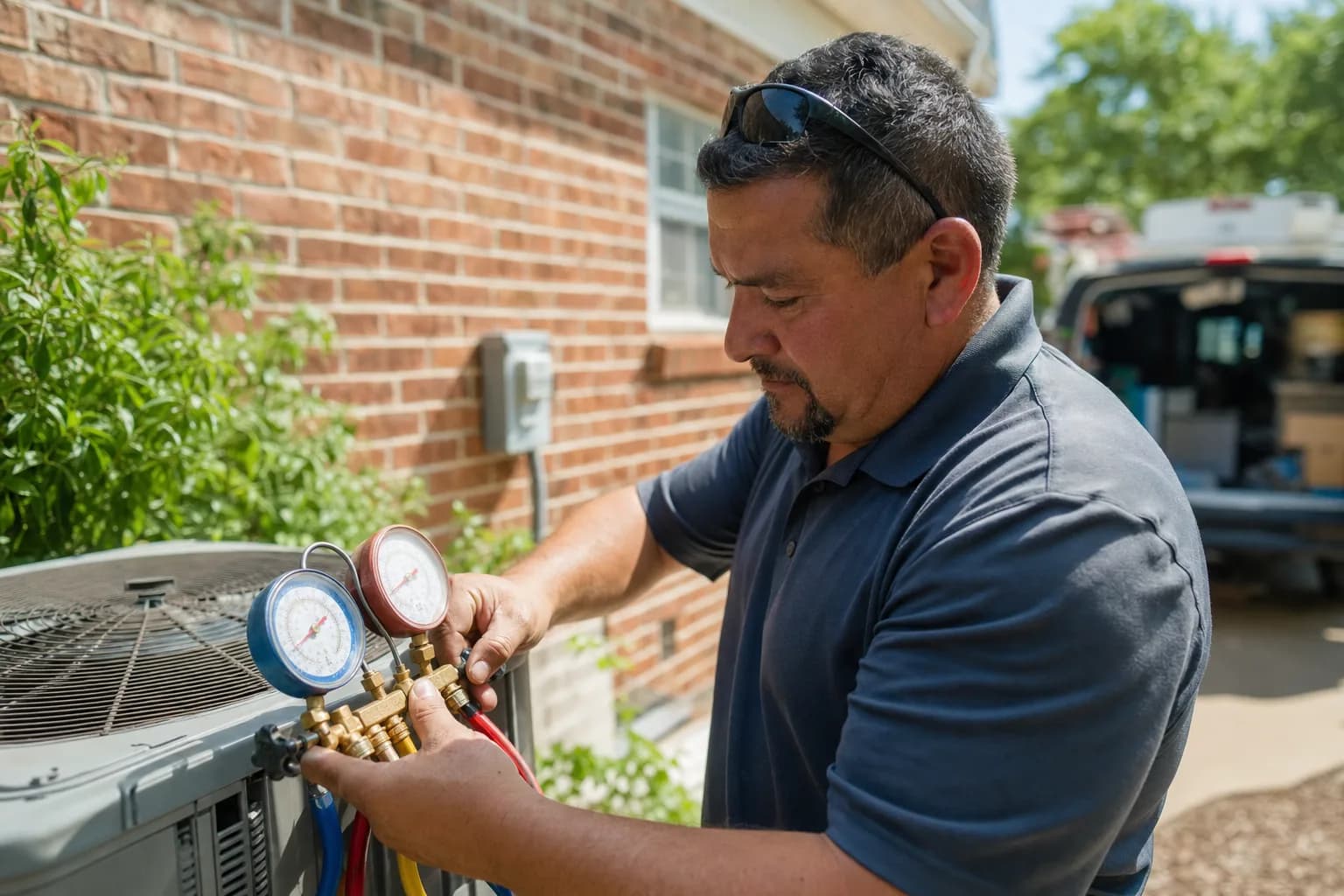
Texas ACR contractors must complete 8 hours of continuing education each year to renew their license with TDLR. This requirement applies to both Class A and Class B contractors. Our TDLR-approved online course covers all required topics — including the mandatory 1-hour Texas law module — with no final exam and an instant certificate upon completion.
ACR Contractor (Class A & B) CE — At a Glance
CE Hours
8
hours
Renewal Cycle
Every year (annual)
Renewal Fee
$65
Course Price
$22.95
Who Needs 8 Hours of ACR Continuing Education?
Under Texas Occupations Code Chapter 1302, all licensed Air Conditioning and Refrigeration (ACR) contractors must complete 8 hours of CE annually. This applies to:
- Class A Contractors — licensed to work on systems of any size (unlimited tonnage and BTU)
- Class B Contractors — licensed for cooling systems of 25 tons and under and heating systems of 1.5 million BTU/hour and under
Registered and certified ACR technicians do not need continuing education — only contractors have this requirement. If you hold a technician designation, see our HVAC Technician CE Requirements page.
What Topics Are Covered?
Your 8 hours of CE must include:
- 1 hour (mandatory): Texas laws and rules governing ACR licensees — Texas Occupations Code Chapter 1302 and 16 TAC Chapter 75
- 7 hours (flexible): Any combination of approved topics, including:
- International Mechanical Code (IMC) and Uniform Mechanical Code (UMC)
- Other applicable mechanical and building codes
- Safety protocols and procedures
- New technologies in HVAC systems
- Energy efficiency standards
- Refrigerant handling and transitions
- Diagnostic techniques and troubleshooting
No final exam is required. You complete the course material — answering only short in-lesson knowledge or attendance checks as you go, depending on the approved course design — and receive your certificate. TDLR does not mandate a proctored exam for ACR continuing education.
Important: You cannot complete the same course more than once for credit — but each approval year brings a new TDLR course number, so your annual renewal course still earns credit.
R-454B Refrigerant Transition: What Contractors Need to Know
The EPA AIM Act is driving a major refrigerant transition that every ACR contractor should understand:
- January 1, 2025: Manufacture/import cutoff for new residential and light-commercial AC and heat-pump equipment using refrigerants with a GWP of 700 or greater (R-410A, GWP ~2,088); new systems can only be built from components made or imported before that date.
- No installation deadline: The May 2026 EPA final rule (effective July 27, 2026) removed the January 1, 2026 cutoff — pre-2025-component R-410A split systems may be installed until inventory runs out.
- January 1, 2028: Sale and distribution of pre-2025 self-contained R-410A products (packaged, window, PTAC) ends; there is no installation deadline for them.
R-454B (GWP ~466) is the primary replacement for residential systems. It is classified as an A2L mildly flammable refrigerant, which means updated safety protocols are required for handling, installation, and service. R-454B systems cannot be retrofitted from R-410A — the two refrigerants are not interchangeable.
Existing R-410A systems can continue to be maintained and serviced throughout their useful life. A2L equipment generally costs more, so contractors should plan for that in quotes and repair-versus-replace conversations.
Insurance Requirements for ACR Contractors
All licensed ACR contractors must maintain commercial general liability (CGL) insurance at all times. The minimum coverage limits for a Class A contractor are:
- $300,000 per occurrence (property damage and bodily injury)
- $600,000 aggregate (property damage and bodily injury)
- $300,000 products and completed operations aggregate
Class B contractors carry lower minimums: $100,000 per occurrence, $200,000 aggregate, and $100,000 products and completed operations aggregate.
Your insurance must be from a provider authorized to sell liability insurance in Texas. A Certificate of Insurance must be on file with TDLR. A lapse in coverage can result in license issues.
Texas does not require a state-level contractor license bond for ACR contractors, though individual municipalities may impose their own bonding requirements.
Renewal Fees and Late Penalties
The annual contractor license renewal fee is $65. If you miss your renewal deadline, late fees apply:
- 1-90 days late: $97.50 (50% surcharge)
- 91 days-18 months late: $130 (100% surcharge)
- 18 months-3 years late: $130, with TDLR executive director approval (a written request by mail)
An expired license means you cannot legally perform ACR work. Once your license has been expired 3 years or more, you can no longer renew — you must reapply as a new applicant.
Tip: Begin the renewal process 30-60 days before your expiration date. All 8 hours of CE must be completed before your license expires. Keep your CE completion certificates for at least 1 year — TDLR may request them.
How to Renew Your Texas ACR Contractor License
Follow these steps to renew your ACR contractor license:
- Complete 8 hours of TDLR-approved CE — our online course satisfies this requirement entirely
- Verify your insurance — confirm your CGL policy is current and on file with TDLR
- Log in to TDLR Online Services at tdlr.texas.gov
- Select your ACR contractor license and follow the renewal prompts
- Pay the $65 renewal fee
- Receive your updated license — your CE hours are reported automatically by approved providers
Note: EPA Section 608 certification is a separate federal requirement for refrigerant handling. It does not expire and is not a substitute for your TDLR ACR license. Most HVAC professionals hold both credentials simultaneously.
Late Renewal Fees
| Time After Expiration | Fee |
|---|---|
| 1–90 days expired | $97.50 (1.5x) |
| 91 days–18 months expired | $130 (2x) |
| 18 months–3 years expired | $130 (2x) — executive director approval required |
| 3 years or more expired | Must reapply as new applicant |
Important: Practicing with an expired license can result in fines of $1,000–$5,000 per violation. Complete your CE before your license expires.
Frequently Asked Questions
Q.01How many CE hours do Texas HVAC contractors need?
Texas ACR contractors (both Class A and Class B) must complete 8 hours of continuing education annually. This includes 1 mandatory hour on Texas law and rules, plus 7 hours on approved technical topics.
Q.02Is there a test required for Texas ACR contractor CE?
No. There is no final exam — just short in-lesson knowledge or attendance checks, depending on the approved course design. You complete the course material and receive your certificate of completion. TDLR does not mandate a proctored exam for ACR continuing education.
Q.03Can I take my Texas HVAC CE course online?
Yes. TDLR fully accepts online delivery of ACR continuing education. Our course is 100% online, TDLR-approved, and can be completed on any device at your own pace.
Q.04What is the difference between a Class A and Class B ACR license?
A Class A contractor can work on HVAC systems of any size (unlimited tonnage and BTU). A Class B contractor is limited to cooling systems of 25 tons and under and heating systems of 1.5 million BTU/hour and under. Both require 8 hours of CE annually. See our Class A vs Class B comparison page for full details.
Q.05Do Texas HVAC technicians need continuing education?
No. Registered ACR technicians and certified ACR technicians do NOT have a CE requirement. They simply pay their annual renewal fee ($20 registered, $35 certified). Only licensed ACR contractors (Class A and Class B) need 8 hours of CE.
Q.06How much does it cost to renew a Texas ACR contractor license?
The annual renewal fee is $65. Late renewal within 1-90 days costs $97.50 (50% surcharge). Late renewal from 91 days to 18 months costs $130 (100% surcharge), and from 18 months to 3 years it stays $130 but requires TDLR executive director approval (a written request by mail); past 3 years you must reapply as a new applicant. These fees are in addition to the cost of your CE course.
Q.07Can I repeat the same CE course for credit?
No. TDLR rules state that you cannot receive credit for completing the same course more than once. Each approval year's course carries a new TDLR course number, so taking your CE from the same provider each year still earns credit — every year is a different approved course.
Q.08What is EPA 608 and do I need it in addition to my TDLR license?
EPA Section 608 is a separate federal certification required for anyone who purchases, handles, or works with refrigerants. It does not expire (lifetime certification). Your TDLR ACR contractor license is a state requirement that expires annually. Most HVAC professionals hold both. EPA 608 is not a substitute for the TDLR license, and vice versa.
Q.09What is R-454B and why should contractors learn about it?
R-454B is the primary replacement refrigerant for R-410A in residential HVAC systems. It has a lower Global Warming Potential (~466 vs ~2,088 for R-410A) and is classified as A2L (mildly flammable). Since January 1, 2025, new residential AC and heat-pump equipment can no longer be manufactured or imported with refrigerants at a GWP of 700 or greater, and the May 2026 EPA final rule (effective July 27, 2026) removed the January 1, 2026 installation cutoff — pre-2025-component R-410A split systems may be installed until inventory runs out. Understanding R-454B safety protocols is critical for contractors.
Q.10How long before my license expires should I complete CE?
TDLR recommends beginning the renewal process 30-60 days before your expiration date. All 8 hours of CE must be completed before the license expires. Starting early ensures you avoid late fees and any lapse in your ability to work legally.