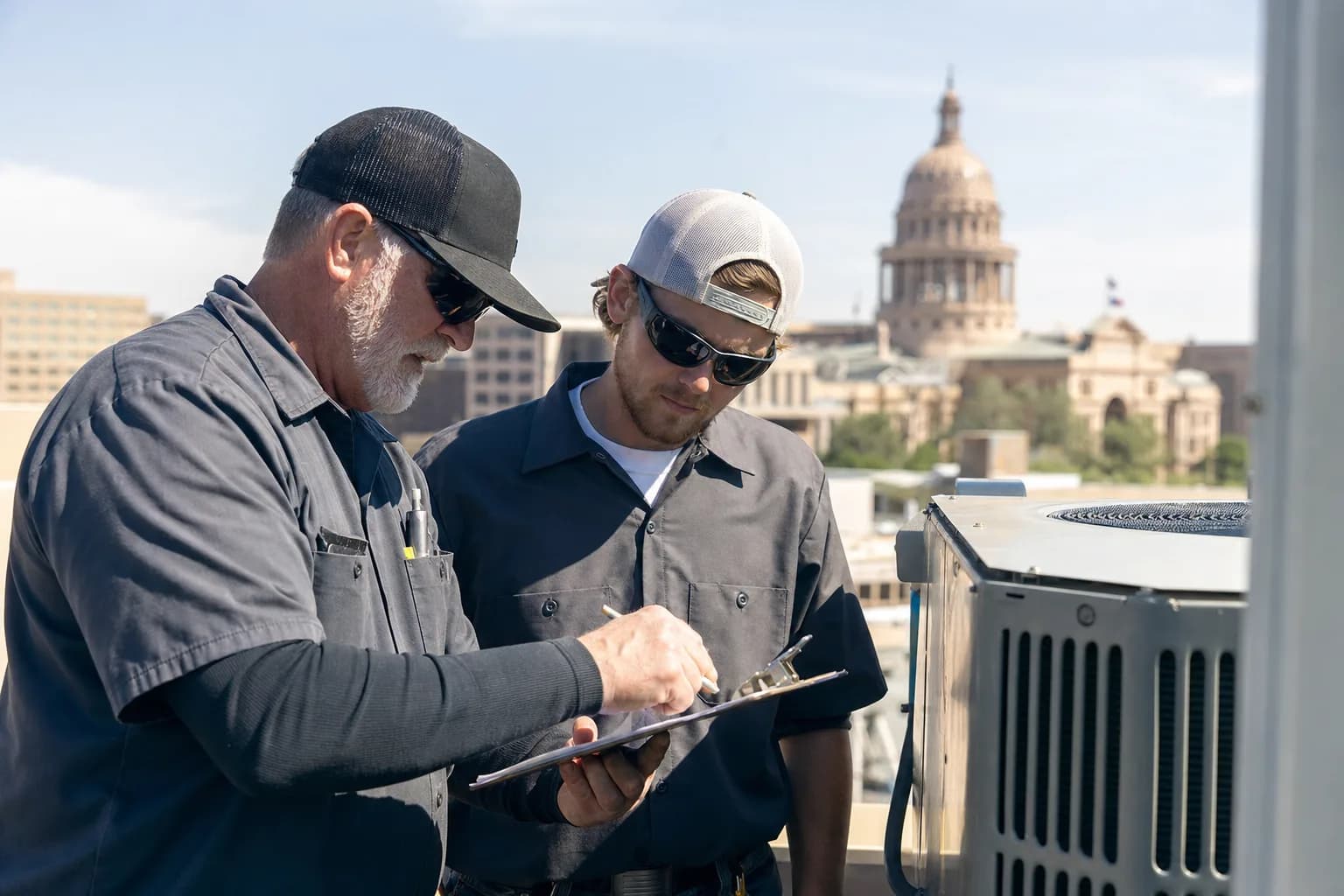
Texas TDLR issues two classes of ACR contractor license — Class A and Class B — each with different scope-of-work limits. Both require 8 hours of annual CE, but the insurance minimums and the type of systems you can legally work on differ significantly. This guide breaks down the key differences to help you understand which license you hold or need.
Class A vs Class B Contractor CE — At a Glance
CE Hours
8
hours
Renewal Cycle
Every year (annual)
Renewal Fee
$65
Course Price
$22.95
Class A vs Class B: Side-by-Side Comparison
| Requirement | Class A Contractor | Class B Contractor |
|---|---|---|
| Scope — Cooling | Unlimited tonnage | 25 tons and under |
| Scope — Heating | Unlimited BTU | 1.5 million BTU/hour and under |
| CE Hours | 8 hours annually | 8 hours annually |
| Mandatory CE Topic | 1 hr Texas law & rules | 1 hr Texas law & rules |
| Renewal Fee | $65/year | $65/year |
| Insurance — Per Occurrence | $300,000 minimum | $100,000 minimum |
| Insurance — Aggregate | $600,000 minimum | $200,000 minimum |
| Experience Required | 48 months under licensed contractor | 48 months under licensed contractor |
| Exam | Class A contractor exam | Class B contractor exam |
| Governing Statute | TX Occ. Code Ch. 1302 | TX Occ. Code Ch. 1302 |
Class A Contractor: Unlimited Scope
A Class A ACR contractor license allows you to work on air conditioning and refrigeration systems of any size — there are no tonnage or BTU limitations. This includes:
- Large commercial HVAC systems
- Industrial refrigeration
- High-capacity process cooling and heating
- All residential systems
Class A is the highest contractor license level issued by TDLR. If you work on or plan to work on large commercial or industrial systems, this is the license you need.
Class B Contractor: Residential and Light Commercial
A Class B ACR contractor license limits your scope to:
- Cooling: Systems of 25 tons and under
- Heating: Systems of 1.5 million BTU/hour and under
This covers the vast majority of residential HVAC work and many light commercial applications. If your business focuses on homes and small commercial buildings, a Class B license is often sufficient.
Working on a system that exceeds these limits with only a Class B license is a violation of Texas Occupations Code Chapter 1302 and can result in disciplinary action.
How to Qualify for a Contractor License
Both Class A and Class B contractor licenses have the same experience prerequisites:
Standard path:
- 48 months of practical ACR experience under a licensed contractor within the past 72 months
- Pass the appropriate TDLR contractor exam (Class A or Class B)
Certified technician path:
- Hold a TDLR certified technician designation for 12 or more months
- 36 months of practical experience under a licensed contractor within the past 48 months
- Pass the appropriate TDLR contractor exam
The new contractor application fee is $115. After passing the exam, you must submit a Certificate of Insurance to TDLR before your license is issued.
Insurance Requirements (Both Classes)
Both Class A and Class B contractors must maintain commercial general liability (CGL) insurance, but the minimums differ by class. Class A:
- $300,000 per occurrence (property damage and bodily injury)
- $600,000 aggregate (property damage and bodily injury)
- $300,000 products and completed operations aggregate
Class B: $100,000 per occurrence, $200,000 aggregate, and $100,000 products and completed operations aggregate.
Insurance must be from a provider authorized to sell liability insurance in Texas. A Certificate of Insurance must remain on file with TDLR at all times. Texas does not require a state-level contractor bond, but municipalities may have their own bonding requirements.
CE Requirements: Same for Both Classes
Whether you hold a Class A or Class B license, the continuing education requirement is identical: 8 hours annually, including 1 mandatory hour on Texas law and rules.
Approved topics for the remaining 7 hours include IMC, UMC, mechanical codes, safety, refrigerant handling (including R-454B transition), energy efficiency, and diagnostic techniques. You cannot repeat the same course for credit.
Our TDLR-approved online course satisfies the full 8-hour requirement for both Class A and Class B contractors — no final exam, instant certificate.
Late Renewal Fees
| Time After Expiration | Fee |
|---|---|
| 1–90 days expired | $97.50 (1.5x) |
| 91 days–18 months expired | $130 (2x) |
| 18 months–3 years expired | $130 (2x) — executive director approval required |
| 3 years or more expired | Must reapply as new applicant |
Important: Practicing with an expired license can result in fines of $1,000–$5,000 per violation. Complete your CE before your license expires.
Frequently Asked Questions
Q.01What is the difference between Class A and Class B HVAC licenses in Texas?
Class A contractors can work on HVAC systems of any size (unlimited tonnage and BTU). Class B contractors are limited to cooling systems of 25 tons and under and heating systems of 1.5 million BTU/hour and under. Both require the same CE, insurance, and renewal fees.
Q.02Do Class A and Class B contractors need the same CE hours?
Yes. Both Class A and Class B ACR contractors must complete 8 hours of TDLR-approved continuing education annually, including 1 mandatory hour on Texas law and rules.
Q.03Can I upgrade from a Class B to a Class A license?
Yes. You must pass the TDLR Class A contractor exam. The experience requirements are the same (48 months under a licensed contractor), so if you already hold a Class B license, you likely meet the experience threshold. Contact TDLR for the upgrade application process.
Q.04How much experience do I need for a contractor license?
Both classes require 48 months of practical ACR experience under a licensed contractor within the past 72 months. Certified technicians have a shorter path: 12+ months as a certified technician plus 36 months of experience within the past 48 months.
Q.05Do I need insurance for both Class A and Class B licenses?
Yes. Both classes require commercial general liability insurance, but the minimums differ: $300,000 per occurrence and $600,000 aggregate for Class A, and $100,000 per occurrence and $200,000 aggregate for Class B. A Certificate of Insurance must be on file with TDLR at all times.
Q.06What happens if I work on a system that exceeds my Class B limits?
Working on systems that exceed your license scope is a violation of Texas Occupations Code Chapter 1302. This can result in disciplinary action from TDLR, including fines and potential license revocation.
Q.07Which license do most residential HVAC contractors need?
Most residential work falls within Class B limits (25 tons cooling, 1.5 million BTU heating). However, if you plan to work on larger commercial systems or want maximum flexibility, a Class A license removes all scope restrictions.
Q.08Do HVAC technicians need a Class A or Class B license?
Technicians (registered or certified) hold a separate designation — not Class A or Class B. Technicians work under a licensed contractor and do not need CE. The Class A/B distinction applies only to contractor licenses. See our technician requirements page for details.